
Loading and stacking systems
Automated for efficient logistics
The Reichenbacher Hamuel Group is a specialized provider of integrated solutions intended for automated production in industry and trade. In cooperation with our partners, we provide both single and double-sided feeding and stacking systems that are compatible with all of our through-feed machines. This results in efficient logistics that bring more transparency and flexibility to your entire production process.
Advantages for your production
- RIncrease in overall system performance
- RTrouble-free production
- RSafeguarding of material quality
- RMinimization of transport times
- RHigh process reliability
Examples
realized on our machines


Picture gallery from the production
Efficient CNC-joinery
Derix GmbH & Co.
Three identical VISION-III-TT 5-axis systems are in use at Derix, each equipped with a 16,500 x 3,600 mm steel beam table, consisting of 23 steel trusses with wooden beam support, and a conveyor system. Our designers have enhanced the experience gained from numerous industrial solutions and adapted it to the required performance for cross-laminated timber (CLT) applications. The result is a system that impresses in its every detail. This applies to the table concept in the same way as to the pressure roller system for fixing the plates or to the extraction device with more than 14 blast gates, which ensure that the extraction power is available precisely where it is needed. The elements leave the factory with cut-outs for windows, doors or electric lines at millimeter precision. To meet these requirements, each of the three CNC-machining centers possesses for all processing steps a proven 5-axis unit with access to a tool changer with 30 places. This is rounded off by a deep-drilling unit for holes in the edge up to 1,800 mm in depth.


Picture gallery from the production
High degree of prefabrication with through-feed system
Regnauer Fertigbau GmbH & Co. KG
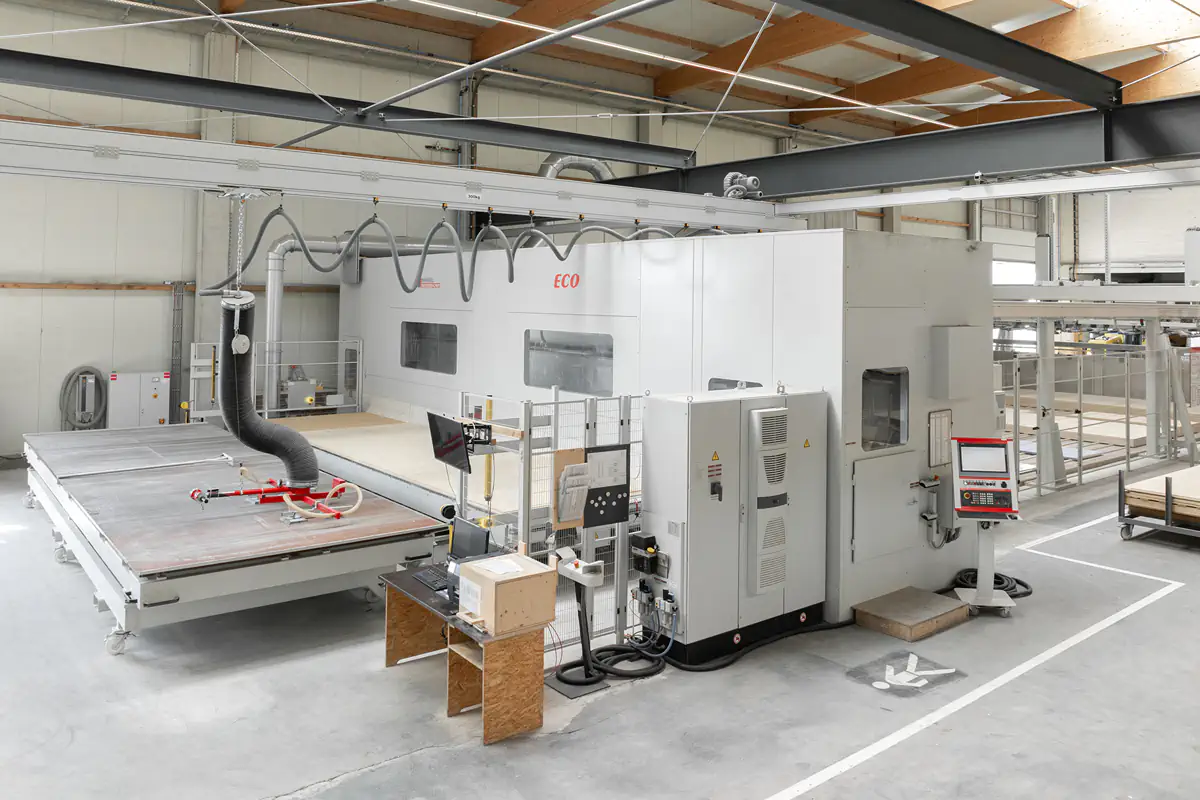
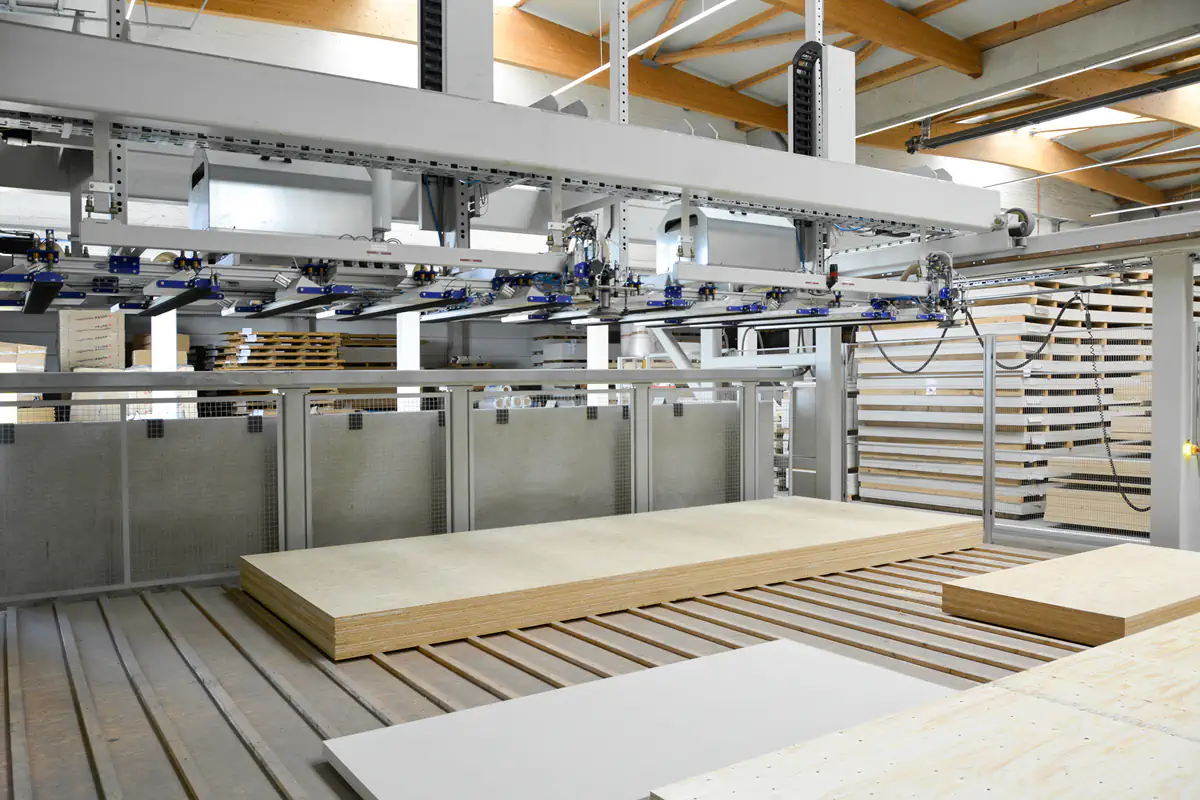
The Chiemgau-based company Regnauer Fertigbau GmbH produces house walls and ceilings with a high degree of prefabrication. Modern automation technology dominates many production steps. Ever since its smooth integration into the existing production line, our highly efficient ECO-3313-A through-feed system has been a central component of the overall process. An area storage system with 14 places precedes it, where the arrangement of the panel stacks is in line with the quantities required, meaning that the panel types most often needed are closest to the milling machine. A flexible gripper system moves raw panels with maximum dimensions of 3.300 x 1.280 x 25 mm and transports them into the CNC unit via a motor-driven roller conveyor. Then, five positionable grippers aligned along the table on a slide hold the panel in place. The sectioning and cutting to size of the panel are the next steps.

Picture gallery from the production
Timber construction with a future
Renggli AG
The Renggli plant in Switzerland fully meets the needs of demanding construction partners in terms of processes, flexibility and performance. The skilled craftsmen at Renggli have strong allies in their high-tech machines. For example, the ECO-3533-B-Sprint panel processing center from Reichenbacher Hamuel, which permits large panels to be processed on both sides and has a fully automatic loading system.
The principle is quite simple: small panels for small areas, large panels for large areas. While small panels hardly cause any problems, large panels can present production companies with major challenges. Here, the ECO from our machine portfolio, which has been specially adapted to customer requirements. comes in to fill the gap in large-format production. The cutting system is able to process panel sizes of up to 3,300 × 7,000 mm. Even for unconventional plate formats, all of this happens fully automatically in a single work step directly after the provision of the digital data. A 40-fold drilling unit makes complex special and row drilling child’s play, while a 5-axis work spindle is available for fast saw set-ups.


Picture gallery from the production
State-of-the-art technology
neuform-Türenwerk Hans Glock GmbH & Co. KG
The Neuform team was looking for a comprehensive yet cost-effective production solution for doors from batch size 1 with short set-up times. Here, contact was made with a Dutch customer who offered three identical Reichenbacher VISION-II-UT systems with gantry loaders for sale. This brought the realization of the Neuform idea within reach.
The U-shaped portal structure of each of the three identical VISION-II-UT systems features two cardanic 5-axis units, which allows a great variety of variants thanks to the possibility of choosing between parallel and single machining. A 60-place chain tool magazine supports the tool change of both units during machining. The through-feed table is equipped with a driven roller track with lifting device. Moreover, there is a fixed suction bar at the front, and a mobile one at the rear, which can be adjusted via the NC axis and is equipped with individually controllable vacuum cups and positioning stops.


Picture gallery from the production
Change through technology
Brüninghoff Group
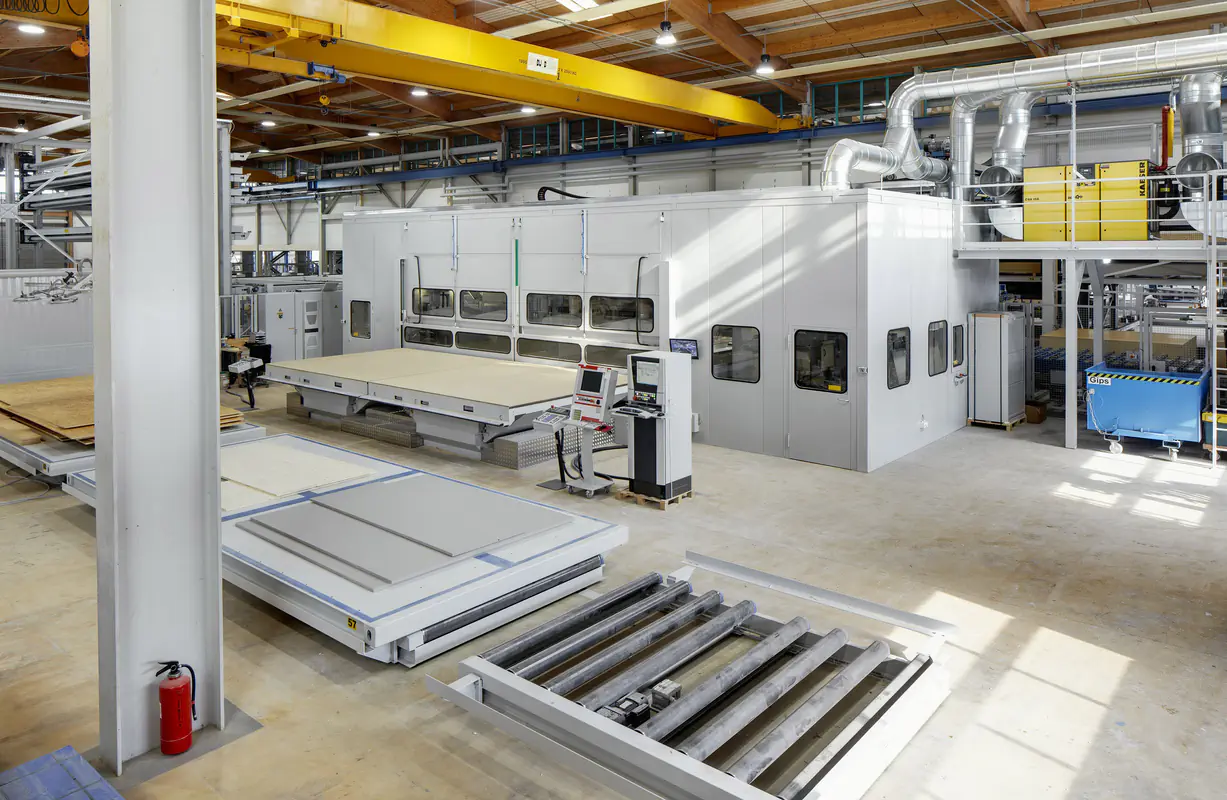
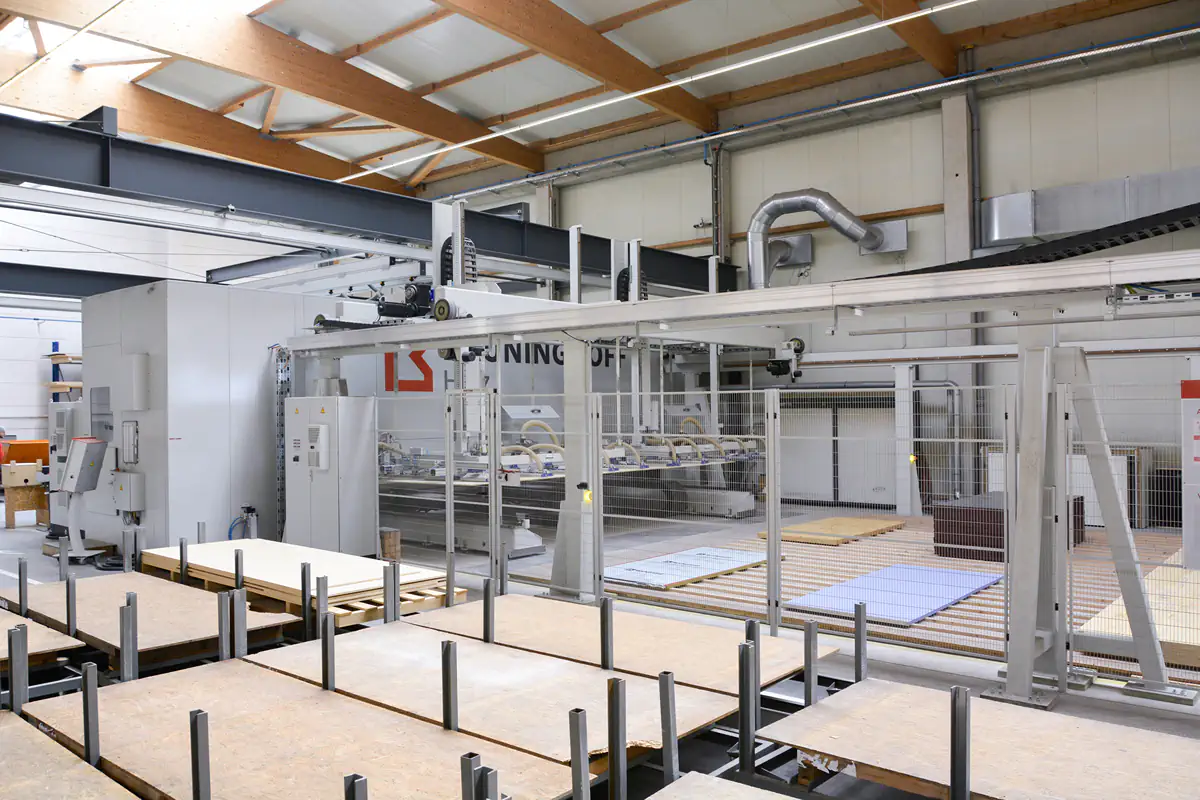
The ECO-8126-A marked the beginning of a new era of process-oriented thinking at Brüninghoff in the field of panel cutting. The goal was a fully automated prefabrication process that seamlessly integrated storage, feeding, cutting, processing, and stacking. With panel formats up to 8 × 2.5 m and weights up to 800 kg, this required a robust solution: The stationary gantry system has a mobile processing table with a grid-patterned HPL table surface and a soundproof cabin to optimally meet the requirements for stability, precision, and working environment.
The technology takes into account the wide range of materials used, including chipboard, OSB, MDF, cement-bonded chipboard, gypsum fiberboard and plasterboard, HPL and three-layer boards, laminated veneer lumber, and softwood fiberboard. The processing strategy defines the exact process sequence, including tool use, the order of processing per panel, and the use of label and inkjet printers for part marking. Nine variable stacking stations ensure optimal cutting results; the stacking sequence is carefully planned so that the subsequent elementation can be carried out quickly. The system is designed for formatting around 140,000 m² of panels per year, depending on the complexity of the machining operations.


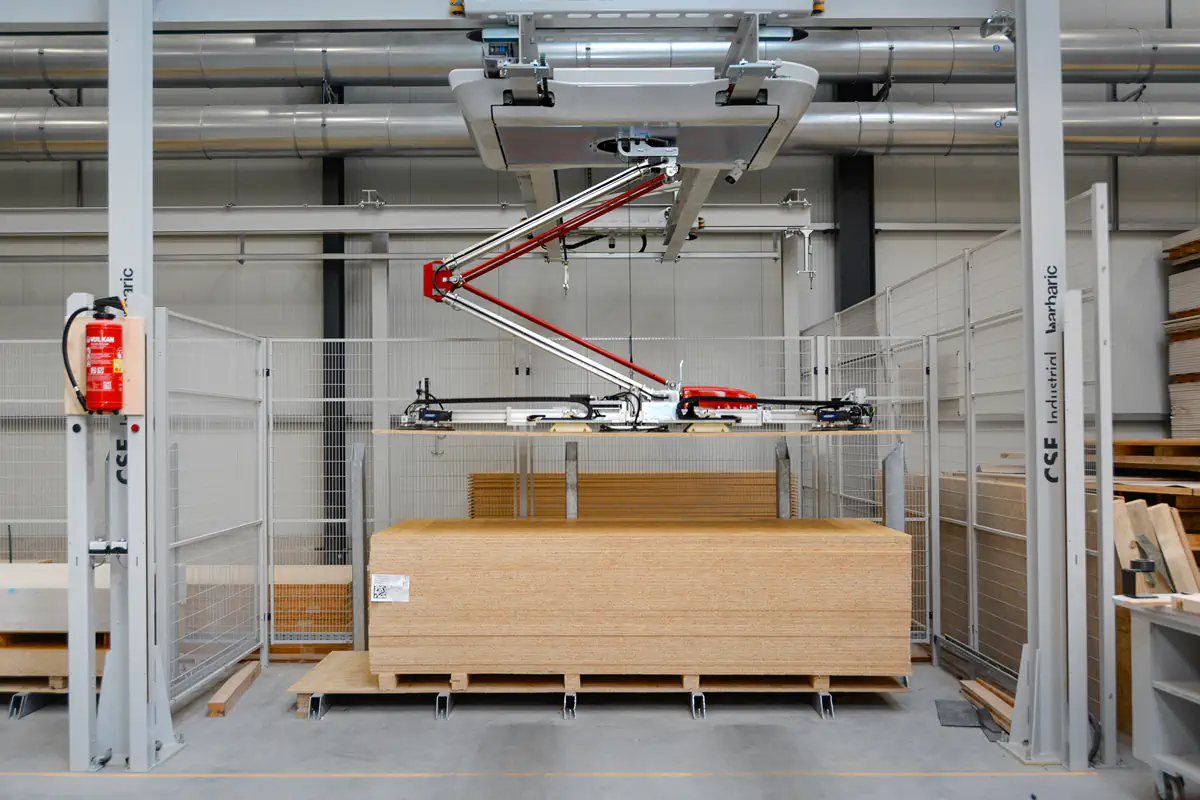
Picture gallery from the production
Panel processing with intelligent automation
Terhalle Holzbau GmbH
At Terhalle in Ahaus, all panels in timber construction are processed fully automatically by the VISION-III-U and machined to order. The sophisticated picking system uses buffer storage for panel sorting so that all parts are always available in the correct order for downstream processes.
In 80 percent of cases, three to four components are produced from one panel, as Terhalle only uses panel sizes up to a maximum of 3.5 × 1.25 m due to easier handling and to avoid breakage. Some of the panel materials generate a lot of dust, which is why a controllable extraction hood is installed to prevent dust explosions and ensure first-class surface quality for dust-sensitive products. Diffuse, porous materials such as soft wood fiberboard are reliably fixed in place using vacuum technology. The machine concept with a 3- and 5-axis unit, which work alternately, minimizes tool change times and increases productivity and flexibility.
Intelligent automation and seamless data communication between upstream and downstream systems ensure a continuous production flow. Lot size 1 production is particularly valued in complex construction projects.